A drawing ready for DFM
Wall thickness, draft, ribs, bosses and gates: prepare the design decisions before injection tooling.
Begin with function, datums and critical dimensions
Before adjusting the mold design, identify how the part locates in the assembly. Mark critical dimensions, datum references, sealing surfaces and appearance zones on the drawing. Separate functional requirements from dimensions that can follow normal molding variation.
Keep wall transitions deliberate
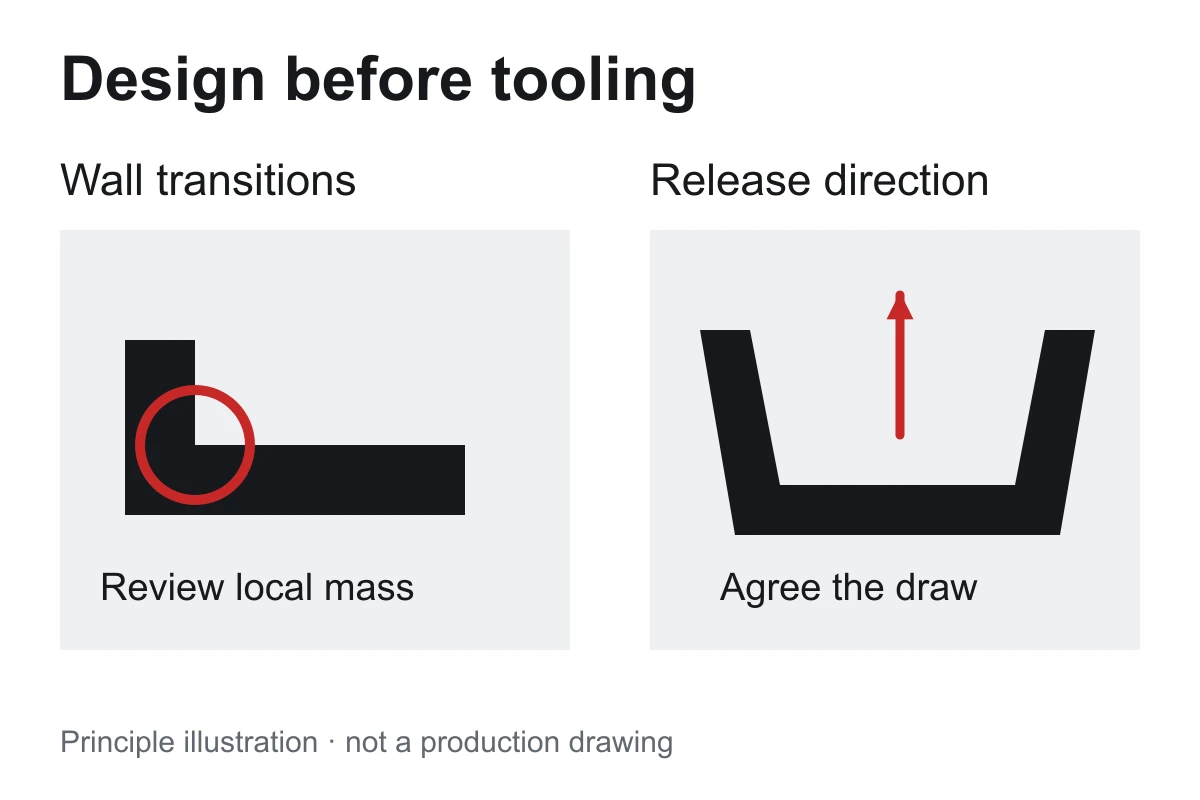
A uniform nominal wall is usually easier to fill and cool consistently. Where a section changes, use a considered transition rather than an abrupt mass of material. Thick intersections at ribs or bosses can cool differently from adjacent walls and create sink or distortion. The appropriate dimensions depend on the resin and part geometry.
Give the part a release direction
Draft helps the molded part release without dragging its surface. Texture, depth, material and the chosen release direction all affect the draft needed. Identify surfaces that cannot change, then review parting lines, slides or other tooling arrangements with the mold designer.
Review ribs, bosses and inserts as a system
Ribs can improve stiffness without making an entire wall thicker. Bosses need support, sensible wall proportions and an assembly plan. For inserts, define how they are located, which regions remain exposed and what retention or torque tests apply.
Agree gates, ejection and cosmetic acceptance
Gate and ejector locations leave evidence on a part. Call out permitted locations and visible faces. Review weld lines, flow length and venting; use mold flow analysis when it will help resolve a project-specific risk.
Send a complete review package
Provide the controlled STEP or IGES model, 2D drawing, resin grade, forecast quantity and appearance requirements. Record design changes and approval before steel is cut. There is no single draft or wall-thickness rule that replaces a review of the actual part.
Prepared for the AAA MOULD injection site using the company’s published DFM, material and process information. Guidance is general; project specifications require drawing and material review.
Tell us what you’re making.
Send the part, material and annual volume. We will review the drawing requirements with you.